

The “handrail micro-revolution” is a term I’ve used for the transformative impact of escalators on the world of advertising, specifically through the implementation of AdRail. It’s a fundamental shift, comparable in its significance to the introduction of billboards or TV commercials, but it’s occurring in a space previously considered purely functional, almost invisible to the strategic advertiser. While traditional Out-of-Home (OOH) mediums like static and digital billboards, and even bus transit ads, focus on a passive “glance-by” exposure, AdRail commands an active, captive audience.
This article is intended to explore why AdRail is so impactful at an expert advertising and psychological level.
The secret is not magic; it’s rooted in deeply ingrained human psychological and physiological responses. AdRail’s effectiveness can be traced back to three foundational components, each a key concept in psychology, sociology, and advertising: dynamic motion, prolonged engagement, and the power of touch.
When these three factors converge, as they do on an AdRail surface, they create an advertising impact that is not only unmatched by other OOH channels but is, quite frankly, a biological imperative for the brain to notice, process, and retain. The psychological weight of this trifecta is what sets AdRail apart and is what we will explore, supported by research from across the behavioral sciences.
The Power of Touch: Engaging the Haptic System
Perhaps the most potent and overlooked weapon in AdRail’s arsenal is its fundamental “touchability”. While other OOH media are explicitly no-or-very-low-touch—static and digital billboards are miles out of reach, cinema screens are distant, and touching a bus or elevator door is often an accidental interaction at best—AdRail’s escalator and people-mover handrail advertising is designed for, and virtually mandates, a physical, hand-to-surface connection.
It’s a psychological reality, rooted in our haptic (touch-based) system. The haptic system is the sensory system by which we perceive and interact with our environment through the sense of touch. From birth, humans use touch to navigate, explore, and form memories of their environment. Research in haptic psychology has repeatedly shown that tactile experiences are linked more directly to memory and emotional processing in the brain than visual or auditory inputs alone.
A pivotal study from the Journal of Marketing Research found that when consumers physically touch a product, or even an advertisement with a tactile element, their sense of ownership and their emotional connection to the brand significantly increases. This “endowment effect”, a well-established concept in behavioral economics and psychology, posits that we value things more simply because we own or have a physical connection to them. AdRail taps into this effect by transforming an ad into a physical object that a consumer is, essentially, holding. While they are not “buying” the handrail, the act of touching it creates a momentary, semi-conscious sense of connection at a psychological level that elevates the ad’s message beyond a mere image to a tactile, memorable experience. That’s one of the reasons AdRail’s third party studies have shown 85% retention rates.
Consider a study by psychologists S.A. Järvilehto and others, which explored the role of touch in memory. Their findings suggested that tactile input can act as a potent memory cue, enhancing the retention of information presented concurrently with the touch. In the case of AdRail, the hand-to-rail connection is the cue, and the ad message is the information. By creating a multi-sensory experience that combines the visual (the ad’s graphics) and the tactile (the physical rail), AdRail effectively doubles the brain’s processing paths, leading to significantly higher recall and recognition rates. The handrail, once a passive background element, becomes an active, psychological touchpoint for the brand.
Dynamic Motion: Capturing the Gaze, Igniting the Brain
The second factor of AdRail’s psychological edge is its inherent and consistent motion. While a static billboard is fixed in place, and even a digital billboard’s “motion” is a sequence of changing still images, AdRail provides a truly dynamic, continuous flow. This is an essential distinction because the human brain is biologically and evolutionary hardwired to pay attention to motion. This is rooted in our survival instincts. Our ancestors needed to detect a predator in the high grass or a ripe fruit from a distance, and their brains prioritized movement for this reason.
In fact, humans are 10x – 50x more likely to notice a moving object than a static one in there periphery. This is most notable articulated by Livingstone and Hubel in their paper, “Segregation of form, color, movement, and depth”, published in the journal Science.
In the context of advertising, movement translates to an automatic, involuntary capture of attention. Our peripheral vision is exceptionally good at detecting movement, and when a person is near or even steps onto an escalator or people-mover, the continuous movement of the AdRail handrail in their periphery inevitably draws their gaze, almost like a primal reflex.
This phenomenon is well-documented in the field of visual attention and psychophysics. A landmark study by Raymond J. Mooney, for instance, demonstrated how motion cues can override other factors in guiding attention. Their work and subsequent research have shown that moving stimuli are consistently processed more quickly and draw more attention than static ones, even when the static stimuli are more visually complex.
This has direct and profound implications for ad effectiveness. While other OOH ads suffer from “banner blindness,” a learned behavior where consumers filter out static visual advertisements in their environment, AdRail’s constant movement prevents this habituation from occurring. (The novelty of AdRail right now also helps capture attention.)
The motion is creating an environment of continuous visual stimulation that forces the brain to remain engaged. The gaze is locked not only by the moving ad itself but by the act of navigating the escalator, which necessitates looking down and forward, putting the moving AdRail directly in the line of sight for an extended period. AdRail transforms a mundane functional space into a dynamic, highly-charged zone of psychological engagement, a feat that static OOH cannot achieve.
Prolonged Engagement: Deepening the Ad’s Impact
The final piece of the puzzle, and perhaps the one that most distinctly separates AdRail from almost all other OOH mediums, is its unmatched duration of exposure. While a passing glance at a billboard might last a mere seven to eight seconds, a commuter or shopper using an escalator is often exposed to the AdRail for a full 30 to 60 seconds. This extended dwell time is a golden window of opportunity for an advertiser, offering a degree of depth that is completely alien to traditional OOH. This long duration isn’t just a metric; it is the cornerstone of deeper psychological processing and a powerful tool for brand building.
The concept of exposure time is foundational to the field of advertising psychology. Many studies have established a clear and positive correlation between the length of time an ad is viewed and its effectiveness across key metrics like brand awareness, recall, message understanding, and purchase intent. For example, Goldstein, McAfee, and Suir’s study, “The Effects of Exposure Time on Memory of Display Advertising.”
The reason for this is intuitive but also backed by research in information processing theory which compares the human mind to computers. Our brains need time to not only notice a message but to process its meaning, relate it to existing knowledge, and encode it into long-term memory. AdRail is an industry leader in providing target audiences this essential time. A person on an escalator or people-mover has very little else to do other than look at their immediate surroundings. Additionally, these pedestrian transportation machines require their attention at the very least during the end of their engagement for a safe departer. (Fun side fact, AdRail improves escalator safety because it draws more attention to the machine than non-Adrail equipped escalators.) The typical distractions of a smartphone are difficult to manage on a moving, crowded escalator or people-mover. This creates a “captive audience,” a scenario that is the advertiser’s dream but the passenger’s functional reality.
Think about a classic piece of sociology/psychology: the Elaboration Likelihood Model (ELM). This model suggests that there are two main “routes” to persuasion: central and peripheral. The central route requires high cognitive effort and elaborate thinking, leading to deep, long-lasting attitude change. The peripheral route is more superficial, relying on simple cues like an ad’s attractiveness or a celebrity endorser, and results in temporary, more easily changed attitudes. AdRail’s long dwell time and lack of significant distraction create an ideal environment for central processing. With over 30 seconds to look at an ad on average, a consumer has the opportunity to read the text, understand the offer, connect with the image, think critically about the brand, and even use their phone to capture the information. They are “elaborating” on the message, leading to a much stronger and more durable brand connection than any seven-second roadside billboard can possibly deliver. This is not just reach; it’s deep, meaningful, and long-lasting connection.
The Psychological Synergies of the Trifecta
As powerful as each of these three factors—touch, motion, and duration—is on its own, their true effectiveness, and what makes AdRail a unique force in OOH, is their synergistic interaction. When a consumer is not just looking at a dynamic, moving ad but physically touching it, for a significant duration of time, the psychological impact is multiplied.
The power of touch enhances the feeling of ownership, making the ad feel more personal and important. The motion captures and locks attention, forcing the brain to remain visually engaged and preventing “banner blindness.” And the extended duration of exposure provides the brain with the necessary time to process, elaborate, and encode the message deeply into long-term memory. This multi-sensory and prolonged engagement creates an experience that is often more memorable, emotional, and persuasive than other OOH channel. Pretty deep and interesting for a seemingly simple solution…hu?
The metric that over-simplifies and captures these results is the CPM Retained. This metric is calculated by taking the standard CPM (Cost Per Thousand impressions) and adjusting it based on the medium’s retention rate, which is a staggering 85% for AdRail. For example, while an indoor static banner at a mall or convention might have a superficially low high-end CPM of $5-$12, its equally low retention rate of 30% according to data based from Solomon Partners, OAAA (Out of Home Advertising Association of America), and Media Monthly (2025 reports). This means that a significant portion of that banner’s budget is being wasted on impressions that are never remembered, resulting in a true CPM Retained of $16.67 – $40.00. AdRail, with a higher but still competitive low-end CPM of $11 – $23, delivers an incredible CPM Retained of just $12.94 to $27.06. For an advertiser seeking more retention and results than overall impressions—AdRail is a very interesting mathematical and psychological option.
The Case Against Other OOH Media
To truly appreciate AdRail’s psychological edge, it is essential to compare it directly to its closest competitors. The weaknesses of traditional OOH are not merely functional; they are psychological ill-equipped as displayed in Figure 1.
- Static Billboards: These suffer from low retention (35%) because they are easy to ignore. Banner blindness is real, and when combined with incredibly short exposure times (:10 high), the brain has neither the incentive to pay attention nor the time to process the information.
- Digital Billboards: While they may seem modern, they often fail for the same reasons as static, with a short exposure time (:10) and relatively low retention (45%). However, their fatal flaw is cost. With a truly astronomical CPM per Second (High) of $5.00.
- Mall Kiosks: Despite offering medium “touchability,” they have an average of only 40% retention and a higher low-end CPM than AdRail. The high “CPM Retained” of $50.00 makes them an inefficient buy for a medium that is often just more noise in a loud environment.
- Cinema: This is AdRail’s closest competitor in a lot of ways for long exposure time (:60 high), captured audience, premium nature, and solid retention (75%). However, it is held back by the highest entry-level CPM in the list ($20 low) and is inherently non-tactile, lacking the psychological force of the AdRail touchpoint.
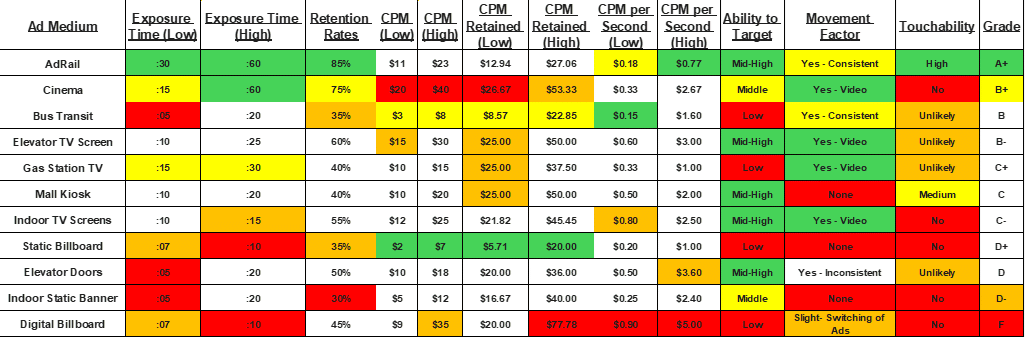
Figure 1: OOH Comparison Grading Chart 2026
Conclusion: AdRail is a Logical Choice for Psychological Impact
We took a deep dive into the advertising and psychological data to showcase the true value of AdRail and how it compares to other mediums. AdRail’s effectiveness is rooted in foundational psychological principles: our biological imperative to notice motion, our haptic system’s deep connection to memory and emotion, and our brain’s need for time to process and encode a message. By creating a multi-sensory, dynamic, and prolonged engagement that is completely unique in the OOH landscape, AdRail delivers an impact that deserves an A+ grading.
While many other mediums offer passive exposure that consumers can easily filter out, AdRail demands active, tactile, and visual engagement, transforming a mundane action into a powerful brand experience. The result is a level of ad recall, brand awareness, and true efficiency that is, quite frankly, a scientific reality of the opportunity’s unique design.
For any advertiser who wants their message to be not just seen but truly felt and remembered, AdRail is a logical choice to consider including in your media mix. AdRail puts brands in the palm of customer’s hands and in the front of their minds.


